By Four Sides Group Published
SAP Business One is the most widely adopted ERP among mid-sized companies in Mexico. Its functionality covers the standard 70% of finance, sales, inventory and production. But there are two scenarios where SAP B1 can't do the job on its own and is best complemented with custom development: when operations require more concurrent users than the licenses you have, and when shop-floor processes or operational areas need functionality that SAP B1 doesn't cover natively.
Why buying more SAP licenses isn't always the best decision
Every SAP B1 license carries a significant recurring cost. For an operation with 60 shop-floor workers who only need to capture specific data (machine readings, barcode scans, quality records), paying for 60 full SAP licenses is out of proportion. The usual workaround — keeping a parallel Excel file and keying everything in at the end of the shift — introduces errors, delays and breaks in traceability.
The strategy Four Sides Group uses in these cases is to build a dedicated custom layer with two-way integration to SAP B1. Shop-floor users work in that layer through interfaces designed for their role (mobile, tablet, scanner), and the data syncs to SAP B1 through its SDK. SAP B1 remains the accounting system of record; the custom layer absorbs the operational volume.
Real-world case: 5 SAP licenses scaled to 60+ users
A furniture manufacturer supplying national retail chains was running on 5 SAP B1 licenses in its offices. It needed real-time shop-floor data capture for 60+ workers — expanding SAP was not viable, both because of cost and because of the complexity of configuring operational profiles in a financial ERP.
Four Sides Group built a dedicated layer with two-way integration to SAP B1 through its proprietary SDK. Workers capture data on the floor (production orders, material consumption, quality, scrap) on tablets. The data syncs to SAP B1 with no manual intervention. The original 5 licenses stayed in place.
Results:
- 5 SAP licenses → 60+ users working on the floor with SAP data.
- Zero additional licenses purchased.
- The project paid for itself in less than a year through license savings and higher productivity.
What Four Sides Group's proprietary SDK solves
SAP B1 integrations that rely solely on the SAP Business One Service Layer run into performance and functional-coverage limits. Four Sides Group complements it with a proprietary SDK (an abstraction layer developed in-house) that:
- Maps SAP B1 entities to domain objects in the custom layer (without coupling the code to SAP structures).
- Queues bulk operations so SAP isn't overloaded at peak hours.
- Applies automatic retries and reconciliation when SAP goes down or slows.
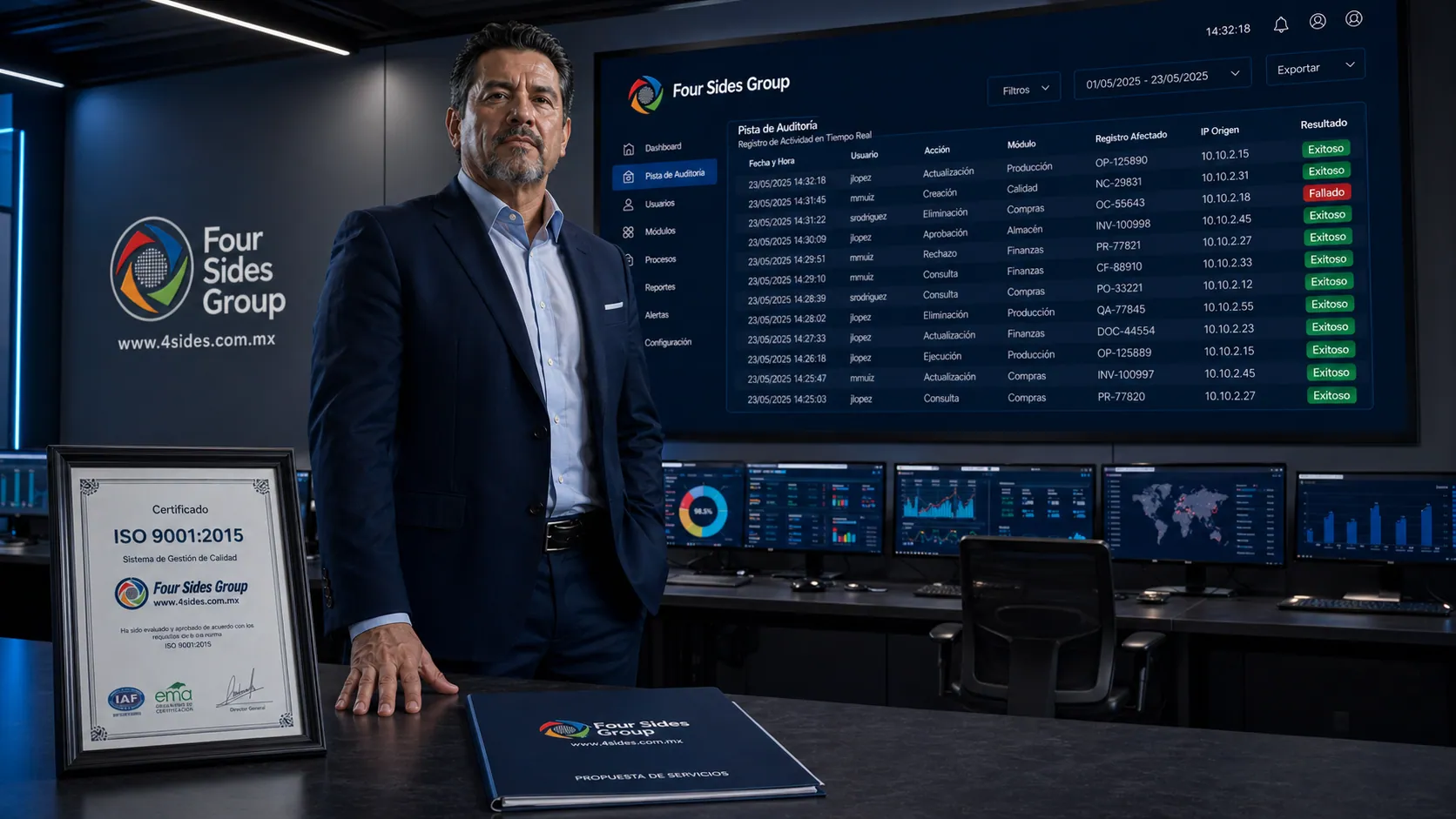
- Audits every transaction with two-way traceability for ISO 9001:2015 certified processes.
- Simplifies versioning: upgrading SAP B1 doesn't mean rewriting the integration.
Types of SAP B1 integration Four Sides Group delivers
Beyond the shop-floor case, these are the typical integrations Four Sides Group delivers:
- Customer and supplier portals: with balance inquiries, CFDI (Mexican electronic invoice) downloads and order entry synced to SAP.
- Shop-floor capture on tablets: production orders, quality, material consumption.
- MES (Manufacturing Execution System): with two-way integration to the SAP production module.
- BI and executive dashboards: real-time reports from the SAP database with business-specific KPIs.
- CFDI 4.0 / PAC connectors: for specific complements that SAP B1 doesn't cover natively (a PAC is the SAT-authorized certification provider for Mexican e-invoices).
- Replication to multi-entity systems: consolidating several SAP B1 instances under a single reporting platform.
The SAP B1 integration process: 4 stages
- Assessment (45 min, free of charge): we confirm your SAP B1 version, the modules in use, operational profiles and expected volume. We identify which parts of the operation are worth moving to a dedicated layer.
- Technical design (2-4 weeks): definition of the integration architecture, entity mapping, security model and parallel data migration plan.
- Sprint-based build: first features in production from week 6, after the initial 3 weeks of analysis and design. Demos every two weeks. Each phase is validated before billing for the next one is authorized.
- Stabilization and continuity: after go-live, a continuity and evolution plan for maintenance, new modules and SAP upgrades.
When custom integration with SAP B1 does NOT make sense
During the assessment, Four Sides Group tells you openly when custom development isn't justified. The typical signs:
- The process to be integrated is already solved by a standard add-on from the SAP marketplace.
- The number of additional concurrent users is under 10 — adding licenses is usually faster.
- The operation is about to migrate to SAP S/4HANA Cloud — the development would lose compatibility.
In those cases, the assessment gives you the criteria to make the decision, free of charge and with no obligation.
Does your operation need more capacity than your current SAP B1 licenses allow?
Request a 45-minute assessment with a senior consultant. We'll confirm whether a custom layer is the best option for your case. ISO 9001:2015 certified processes. Free of charge, no obligation.
Request an assessmentRead also: examples by industry · multi-entity, multi-RFC · how much it costs
Published by Four Sides Group's Management · Updated May 21, 2026.