By Four Sides Group Published
Multi-entity operations — two or more legal entities under the same corporate group — are one of the scenarios where custom software delivers the most value compared with commercial SaaS. The reason is structural: most off-the-shelf products assume one tax entity per instance, forcing corporate groups to run as many separate instances as they have legal entities and to consolidate manually in parallel spreadsheets at every close.
The pattern multi-entity operations keep repeating
Across dozens of assessments with Mexican corporate groups, Four Sides Group sees the same pattern:
- Each legal entity runs its own system (sometimes the same SaaS in separate instances, sometimes entirely different systems).
- Accounting and operating criteria are not identical across entities — individuals and companies (personas físicas and personas morales) under different logic, mixed tax regimes, different invoicing schemes.
- The month-end consolidation is assembled manually in Excel from data exported out of each system.
- Executive reports to the board or shareholders are built days late and with a risk of mismatches.
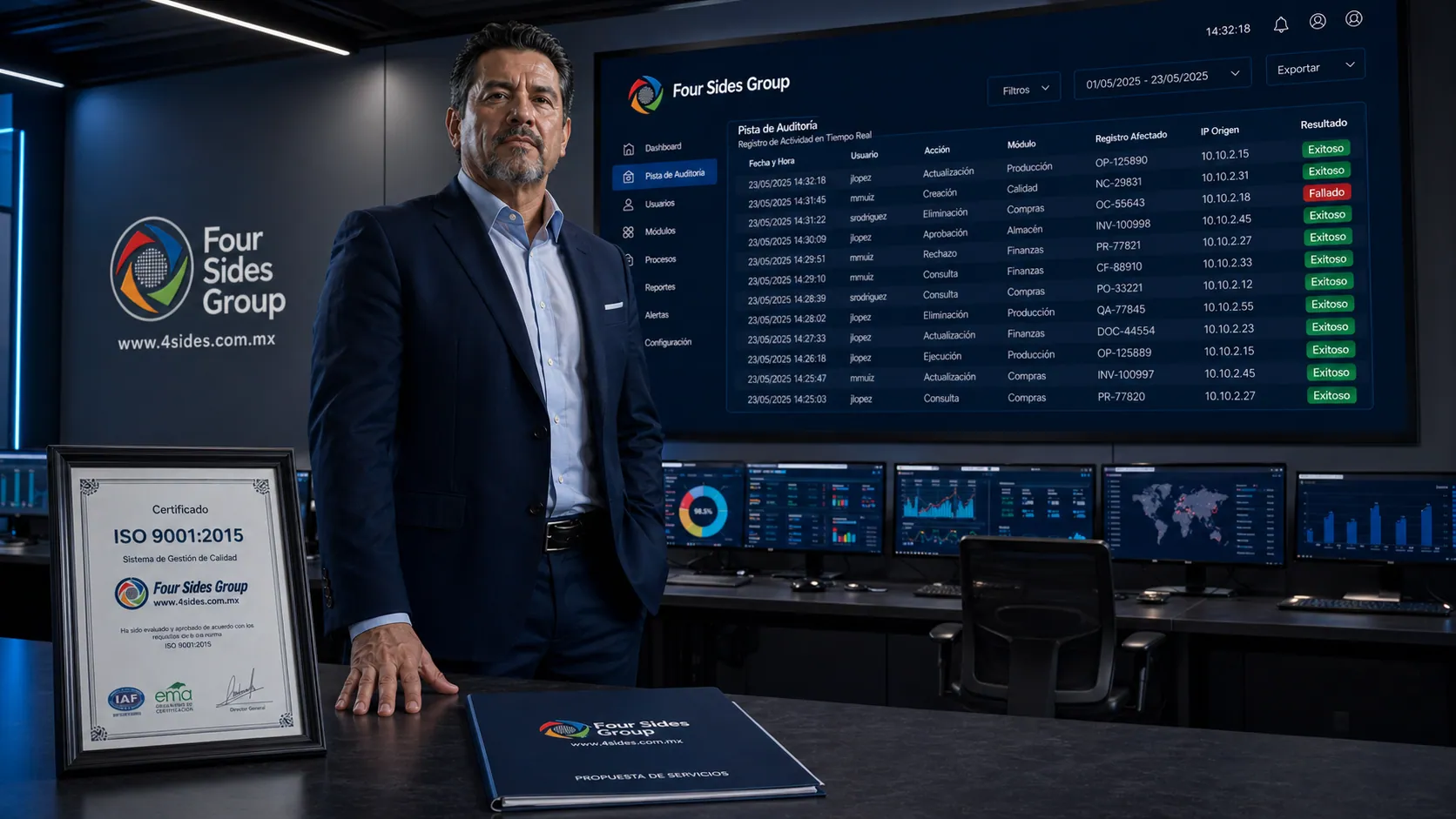
- Regulatory audits (SAT, CNBV, ISO certification bodies) are handled by searching manually in each system.
The cost isn't just staff time — it's the risk of mismatches, rework at close and a lost decision window: by the time consolidated data reaches the board, days have passed since the operational close.
What changes with a custom multi-entity system
Custom software designed for multi-entity operations starts from a simple principle: the tax entity is a field, not an instance. The data model lets you record transactions against any legal entity in the group, with different rules and criteria per entity, and consolidate on the fly with no manual work.
The typical features Four Sides Group delivers in this scenario are:
- Native multi-RFC model: several Mexican tax IDs (RFC) under one group, where every document (invoice, journal entry, receipt) declares its tax entity. Consolidation is a view, not an export.
- CFDI 4.0 compliance per entity: integration with the corporate PAC (the SAT-authorized e-invoice certification provider) and handling of entity-specific complements.
- Mixed rules for individuals and companies: different validations by tax regime and by line of business for each entity.
- Automatic consolidation: executive reports for the group with up-to-date data, not just at close.
- Security by legal entity: roles that see only their own entity or the consolidated view, according to internal policy.
- Corporate ERP integration: two-way with SAP B1, Oracle, Dynamics or legacy systems.
Real-world case: 4 legal entities in a single context
A Mexican financial operation was handling individuals and companies under different logic. Month-end consolidation used to take days across separate systems, with frequent mismatches that the accounting team was slow to track down.
Four Sides Group built a custom platform that centralizes compliance, tracking and financial control for the 4 legal entities in a single context. Every transaction declares its tax entity, and consolidation runs on the fly. Executive reports for the board are produced in hours, not days.
Result: monthly close went from days to hours, with complete document traceability for each tax entity.
When custom multi-entity software makes sense vs. adapting SaaS
Custom development isn't always justified. These are the criteria Four Sides Group applies during the assessment:
- 2 legal entities with identical criteria: evaluate a multi-instance SaaS before custom development.
- 3+ legal entities with mixed criteria: the ROI of custom development is justified by savings at close and lower regulatory risk.
- Frequent regulatory compliance (SAT, CNBV, COFEPRIS): the custom system natively supports audits that SaaS doesn't account for.
- Corporate ERP integration: almost always signals that the group is already large enough for dedicated development.
Typical investment ranges for multi-entity platforms
A custom multi-entity platform at Four Sides Group starts at USD 60,000+ (approximately $1,200,000 MXN). The specific scope is defined in the technical and commercial proposal after the assessment. Read the complete 2026 cost guide for more detail.
Does your group run 2+ legal entities and consolidate manually at every close?
Request a 45-minute assessment with a senior Four Sides Group consultant. ISO 9001:2015 certified processes. The assessment is free of charge, with no obligation to continue.
Request an assessmentRead also: examples by industry · integrating with SAP B1 · foreign trade compliance
Published by Four Sides Group's Management · Updated May 21, 2026.