By Four Sides Group Published
When many factories reach the point of digitizing their operations, they face three main options: build something custom, buy a MES (Manufacturing Execution System) or extend an industrial ERP. All three solve similar problems, but with different approaches.
What each type of software solves
Industrial ERP
SAP, Oracle JD Edwards, Infor, Microsoft Dynamics. It manages the entire business: purchasing, sales, inventory, accounting, high-level planning, HR and tax compliance. It is the company's core system.
MES (Manufacturing Execution System)
It operates on the shop floor, between the ERP and the equipment: detailed scheduling, work order control, lot and serial traceability, equipment monitoring, in-process quality control, and capture of scrap and downtime.
Custom software
It is built specifically for a factory's particular operation: functions that cover unique processes, integrations with proprietary equipment, specific reports and workflows adapted to the staff.
How the three relate
They are not mutually exclusive. The most common architecture in mid-sized and large factories combines all three:
- ERP managing the entire business
- MES running the shop floor
- Custom software covering specific gaps
An ecosystem, not a single decision
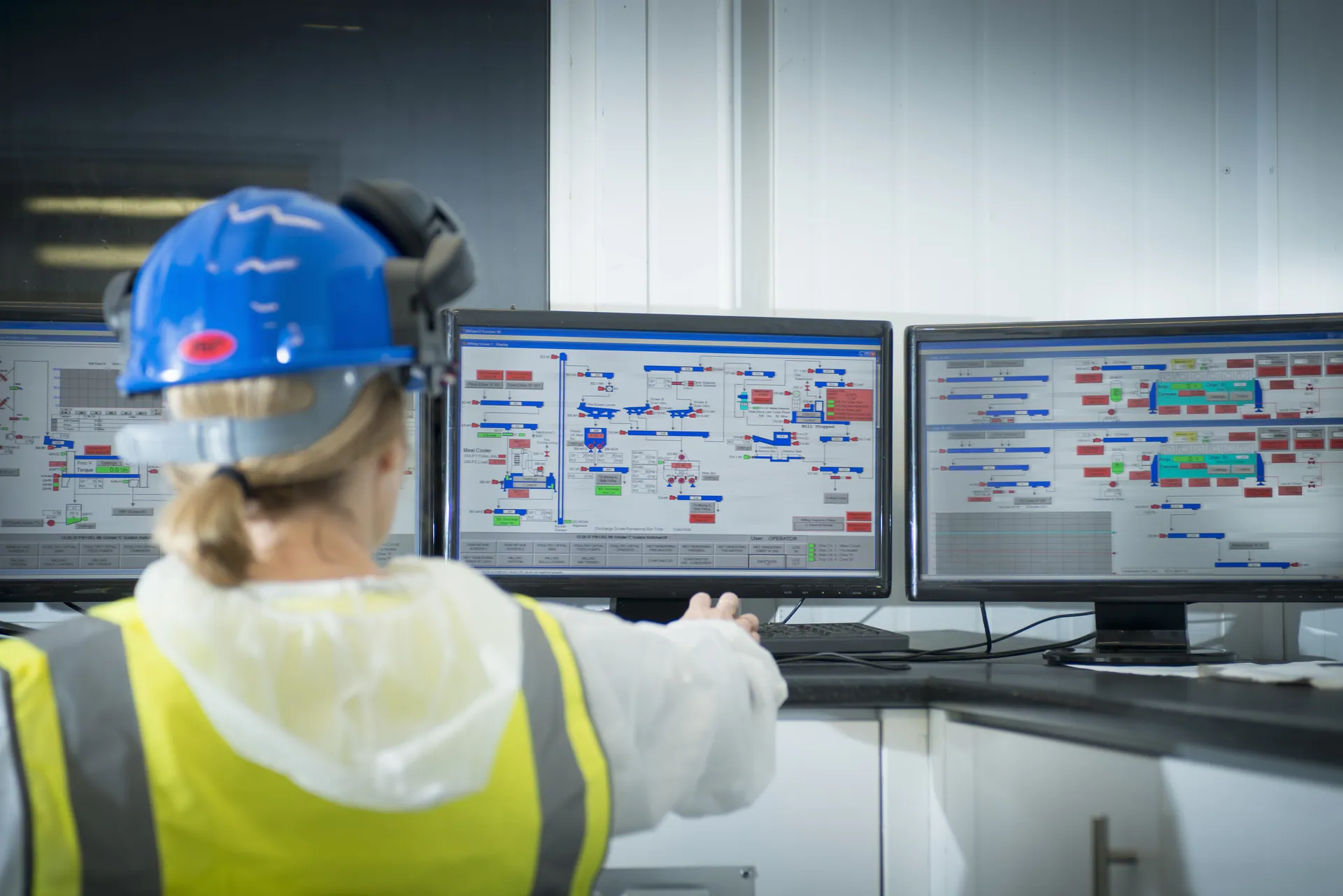
Most successful mid-sized factories don't choose between ERP, MES and custom software: they combine them. The ERP manages the entire business, the MES runs the shop floor and custom software covers the specific gaps. An integrator makes sure they all talk to each other without silos.
Comparison by dimensionCost, time, flexibility and maintenance
| Dimension | Industrial ERP | MES | Custom software |
|---|---|---|---|
| Cost | High | Medium-High | Varies with scope |
| Implementation time | 9-24 months | 6-18 months | 3-12 months |
| Flexibility | Low-Medium | Medium | Total |
| Maintenance | Vendor dependency | Similar to ERP | Full control |
| Support / community | Broad (market leaders) | Niche | Depends on provider |
When each option makes sense
When an industrial ERP makes sense
- Mid-sized or large company with multiple departments (sales, purchasing, accounting, HR, production)
- Operations that are relatively standard for the industry
- Production processes aligned with what the ERP supports
- Ample budget and a long-term horizon
- Need for robust tax compliance
When a MES makes sense
- Complex shop-floor operations with multiple lines or cells
- Detailed traceability at the lot, serial or equipment level
- Real-time quality control during production
- Industrial equipment with integrable interfaces
- Production volume and complexity justify the investment
When custom software makes sense
- Unique processes that commercial systems don't cover well
- Proprietary or highly specialized plant equipment
- An ERP or MES that works but has specific gaps to close
- A limited budget but clear, well-scoped needs
- Operations change frequently and flexibility is critical
Typical scenarios
A: "We have an ERP, but the shop floor runs on Excel"
Outdated information, no traceability, errors. Typical solution: custom software that captures data on the floor and integrates with the ERP. Alternative: a commercial MES if the volume justifies it.
B: "We want to start digitizing from scratch"
A small or mid-sized manufacturer with 30-80 employees and simple operations. Typical solution: a lightweight off-the-shelf ERP + custom software for unique processes. A MES is probably overkill.
C: "We have complex operations with multiple lines"
A mid-sized to large factory with 200+ employees, multiple lines and critical quality requirements. Typical solution: ERP + commercial MES, with custom software to integrate both or cover specific cases.
D: "Our processes are very particular"
Make-to-order manufacturing with heavy customization, products with hundreds of variants. Typical solution: custom software built specifically for the operation. ERP for administration; the production side is custom.
How to decide, step by step
- Map the current state. What systems you have, which processes are manual, where the real pain points are.
- Classify your needs. Separate what is "industry standard" from what is "unique to our company."
- Evaluate investment vs. return. Quantify the current cost of the problem and the expected cost of each option.
- Proof of concept. Before the big investment, test with one module or production line.
- Phased implementation. Deliver value early and adjust based on what you learn.
Frequently asked questions
Can I replace my ERP with custom software?
Technically yes, but in practice it rarely makes sense. An ERP covers many areas where standardization and regulatory compliance are advantages.
Is a MES mandatory in large factories?
No, but it becomes almost inevitable as volume and complexity grow. The alternative is losing traceability, quality control and efficiency.
How much does custom manufacturing software cost?
It depends on scope. Small projects start in the hundreds of thousands of MXN; complete platforms run several million. See cost ranges.
Can I integrate a commercial MES with custom software?
Yes, and it is common. Modern MES platforms have APIs that developers can consume to extend their capabilities.
What happens if I choose wrong?
Switching later is costly but possible. The lesson: start by understanding your operation well before you commit.
Conclusion
There is no universal answer. It depends on size, complexity, how unique your processes are and budget. Many successful factories combine all three approaches: ERP as the administrative backbone, MES or custom software for the shop floor, and specific integrations wherever needed.
Need to evaluate the best approach for your factory?
We build custom software for factories and design the right architecture around your existing systems
See the Solution Book a Consultation